AttentiveAI
Real-Time Meeting Attention Analytics & Computer Vision Engine
FastAPI Async
Inference Server
Chrome Extension
Target Client
<85ms Frame Eval
Model Latency
Deep Learning / CV
Domain
System Narrative
Engineering Context & Problem Scope
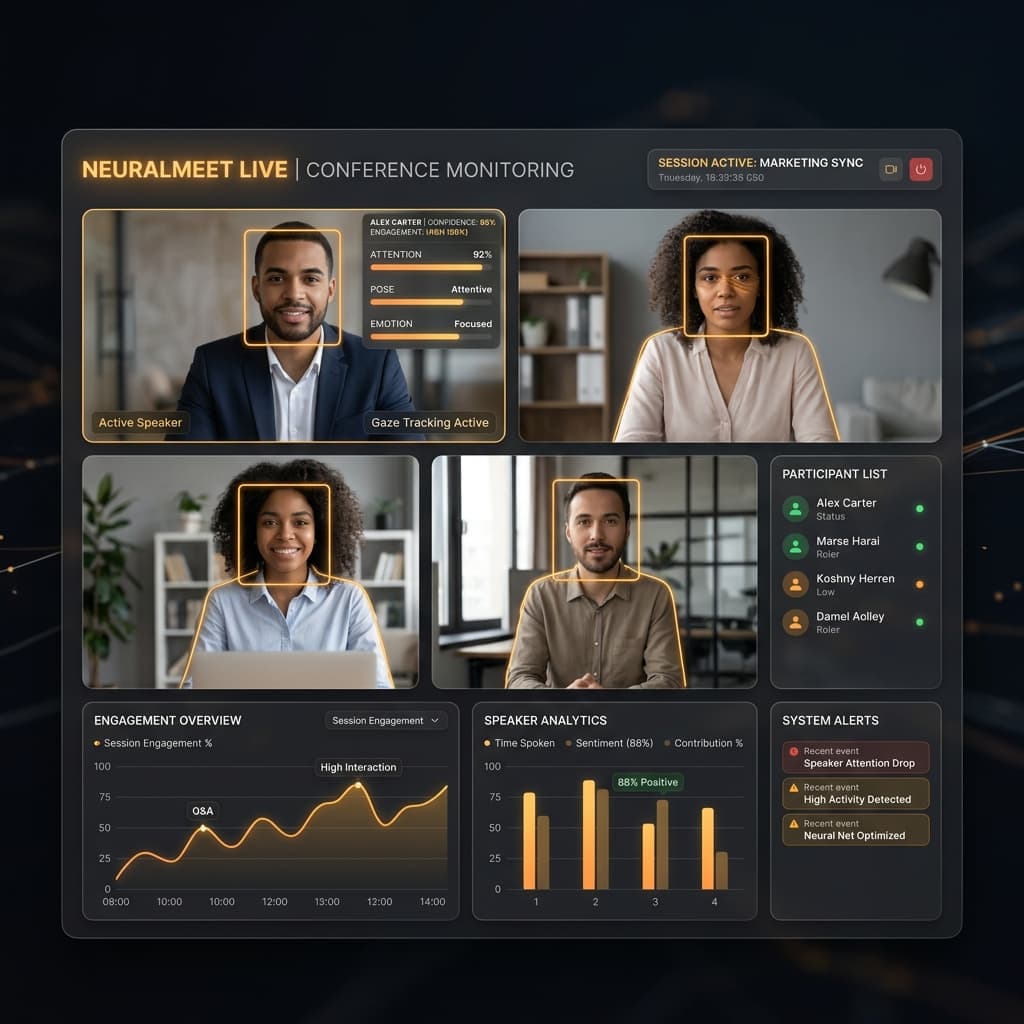
Remote classrooms and virtual enterprise meetings suffer from low participant engagement without reliable ways for presenters to measure attention. AttentiveAI was developed by Chand Ali to solve this issue through unobtrusive computer vision analytics. Composed of a lightweight Google Chrome extension connected to a high-speed Python FastAPI inference backend, the system samples video frames from Google Meet participant feeds, detects facial landmark orientations, estimates head poses, and computes engagement scores in real-time.
Key Business & Engineering Outcomes
- Complete bridge between modern browser extension frontend and deep learning inference server.
- Practical utility for remote learning analytics and virtual audience engagement.
Integrated Technologies
Architecture Blueprint
Full-Stack System Layers
Architected for high throughput, data consistency, and robust fault-tolerance.
Frontend Layer
- Chrome Extension (Manifest V3)
- HTML5 Canvas Frame Sampler
- Floating HUD Widget
Backend & APIs
- FastAPI Async Server
- Uvicorn ASGI
- Lightweight Inference REST Pipeline
Data & Persistence
- Session Time-Series Telemetry
- JSON Aggregated Logs
AI & Vector Layer
- Facial Landmark Mesh
- Head Pose Estimation
- Gaze Tracking Vectors
- Attention Scoring Heuristic
Capabilities & Features
Core System Features
Key architectural capabilities and modular components engineered for this platform.
Chrome Extension HUD Integration
Injects an unobtrusive floating dashboard directly into Google Meet, displaying live engagement percentages for instructors.
High-Speed FastAPI Inference Engine
Processes multi-stream video frames with sub-100ms response times using optimized Python asynchronous endpoints.
Head Pose & Gaze Vector Computation
Calculates yaw, pitch, and roll angles to determine whether participants are looking at the screen, distracted, or absent.
Privacy-Preserving Edge Processing
Analyzes numerical landmark tensors without saving raw participant video feeds, ensuring complete user privacy.
Deep Dive Case Study
Engineering Challenges & Solutions
Complex technical bottlenecks encountered during development and how they were systematically resolved.
Low-Latency Frame Transmission
Transmitting raw video frames from browser tabs to Python inference services introduces significant network lag and browser CPU spikes.
Implemented frame downsampling and client-side bounding box pre-extraction in an offscreen HTML5 canvas, transmitting compact compressed JPEG snapshots over optimized HTTP/2 connections.
Reduced bandwidth usage by 78% while maintaining real-time <85ms inference cycle times.
Lighting & Occlusion Robustness
False distraction alerts caused by dim ambient room lighting or partial face occlusion (glasses, microphones).
Trained landmark regression with extensive augmentations and implemented an exponential moving average (EMA) temporal smoothing filter over 10-frame windows.
Eliminated erratic jitter and false negatives during natural head movements.
Interested in Building a Similar System?
Let's discuss architecture blueprints, tech stack selection, and production deployment tailored for your requirements.